Quick Answer
The best grass for your yard depends entirely on your sunlight and lifestyle. Bermuda is perfect for full-sun yards (8+ hours), Zeon Zoysia is the premium choice for partial shade (4+ hours), and Sunbelt Bluegrass is a great new low-seeding alternative for cooler microclimates. For heavy shade under mature trees, skip the struggling natural turf and opt for artificial grass.
Over the last 11 years of working with lawns across the Atlanta area, specifically transforming yards in Decatur, North Druid Hills, and Tucker. I have tried just about every type of grass you can imagine. When you live in a transition zone, choosing the right turf isn’t just about picking what looks pretty at the garden center. It is a daily battle against red clay, heavy canopy shade, and the blistering heat of a Georgia summer.
You want a lawn that looks lush, but you also need one that survives. Before we dive into the specifics of what actually works in our area, here is a quick summary of how the top contenders stack up. Take a look at the quick breakdown below, and then we will dive deeper into the pros and cons of each.
Atlanta Turf Comparison at a Glance
| Grass Type | Sun Requirement | Maintenance | Winter Color | Best For |
| Bermuda | Full Sun (8+ hrs) | Moderate | Dormant (Tan) | Families & Pets |
| Zoysia (Zeon) | Partial Sun (4+ hrs) | Moderate | Dormant (Tan) | Luxury Look / Shaded Yards |
| Tall Fescue | Partial Shade | High (Summer) | Green | Cooler Microclimates |
| Sunbelt Bluegrass | Partial Shade | Moderate | Green | Fescue Alternative |
| Artificial | Any | Minimal | Green | Zero-Water / High Traffic |
Bermuda Grass: The Full-Sun Workhorse
I can’t talk about local lawns without starting with Bermuda. It is the gold standard if you have a wide-open, sunny backyard, which we see a lot in neighborhoods around Tucker. It thrives in the heat and recovers from heavy foot traffic faster than anything else. If you have big dogs or kids playing soccer, Bermuda is your best bet.
Just remember: Bermuda has zero shade tolerance. If your yard gets less than 8 hours of blistering sun, Bermuda will eventually fade away and leave you with bare dirt.
Zoysia: The Ferrari of Atlanta Grasses
If Bermuda is the reliable daily driver, Zoysia is the Ferrari. It is undeniably gorgeous, providing that thick, barefoot-friendly carpet look that chokes out weeds naturally. But, just like a sports car, it comes with a higher price tag.
Zeon Zoysia is the absolute premium choice around here. It commands top dollar, largely because it is a patented variety that growers have to pay licensing fees to produce. But you get what you pay for. If you live in Decatur with those beautiful, mature oak trees shading your property, Zeon is incredibly shade-tolerant for a warm-season grass; it only needs a
minimum of 4 hours of direct sunlight to thrive.
If the Zeon price tag gives you sticker shock, there are more affordable Zoysia varieties out there, like Zenith and El Toro. Just keep in mind that those varieties are not nearly as shade-tolerant as Zeon and will require significantly more sun to keep from thinning out.
The Great Fescue Misconception
Let’s clear up a major myth I hear all the time: Fescue is not a “shade grass.”
People think Fescue loves the shade because that is the only place it seems to survive in Georgia. The reality is that Fescue is a cool-season grass. It depends on cooler soil temperatures to survive. The shade from your trees just happens to keep the dirt from boiling during the summer.
Because we live in Hotlanta, Fescue is inherently high maintenance. As anyone in North Druid Hills knows, the August heat will inevitably burn patches of it out, meaning you are committing to a cycle of repetitive aeration and reseeding every single fall. While Fescue boasts a much cheaper initial investment compared to laying Zoysia or Bermuda sod, it tends to bite you back with significantly higher water bills just to keep it on life support from June through August.
Sunbelt Bluegrass: The New Kid on the Block
The new kid on the block is Sunbelt Bluegrass, and it is becoming increasingly popular in our area. The massive appeal here is that, unlike Fescue, it doesn’t require repetitive reseeding every year. However, because it is also a cool-season grass, the timing of the installation is key. If you don’t lay it at the exact right time of year, it will struggle to establish before the
Georgia heat kicks in.
Artificial Turf: The Cheat Code
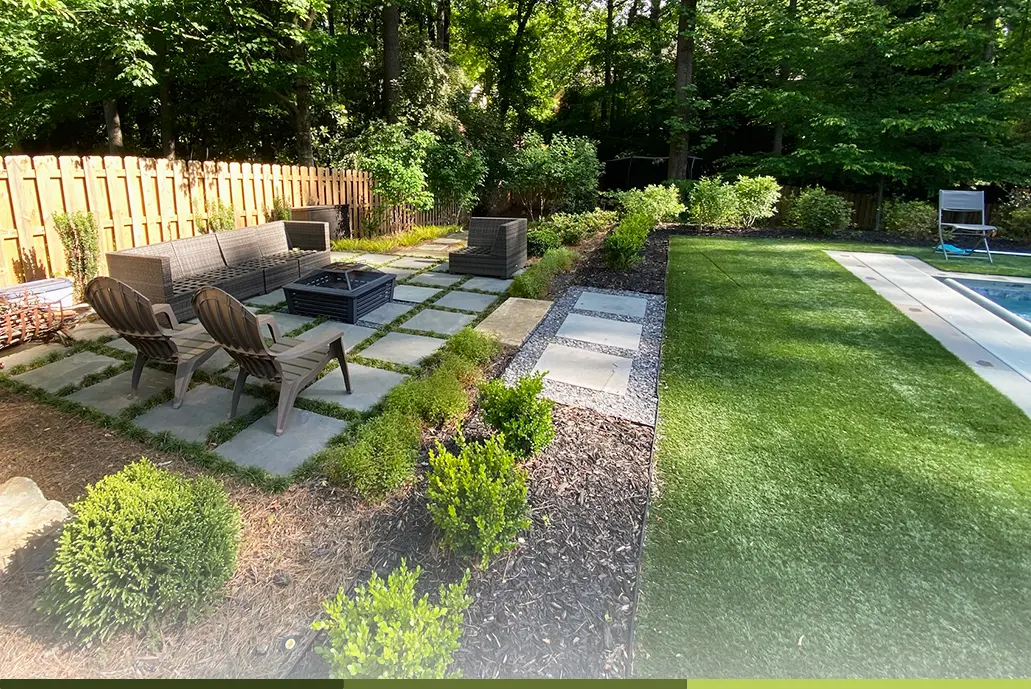
For heavily shaded spots, dog runs, or tight city lots where nothing seems to grow, artificial turf has become an incredibly popular alternative. The upfront cost is high, but it gives you a perfect, mud-free yard 365 days a year with zero watering, mowing, or chemicals.
The Final Verdict on Lawn Design
Grass is a fantastic solution for quality family time: playing ball, running around with the dog, and creating memories in your own backyard. But let’s be honest: a lawn represents a large input of resources, from water and fertilizer to time and money.
That is why I always tell my clients that we need to plant grass where it can actually be used. Keep it in the flat areas where everyone can play and enjoy it. Using grass just as a default filler on long, steep slopes? That is just lazy, unimaginative design.
Choosing the wrong grass, or putting it in the wrong place, is one of the most expensive landscaping mistakes you can make. After 11 years of seeing what works and what fails in Atlanta, Decatur, North Druid Hills, and Tucker, I can tell you that success comes down to matching the turf to your exact soil, sunlight, and lifestyle.